Application Integration We continue our PostgreSQL Integration blog series, which started with an article. Now, we will continue exploring PostgreSQL integration to enable organizations to work more and faster.
This blog post focuses on another important topic in the field: Data Integration and Migration.
Data Integration and Migration
Successful PostgreSQL® applications fully integrate with the corporate environment and do not create “data silos.”.
PostgreSQL has a capability that allows it to integrate into the ecosystem it resides in: Foreign Data Wrappers (FDWs), which are an implementation of the SQL/MED standard. FDWs were first introduced with PostgreSQL 9.1 and today are mostly used for the integration of remote PostgreSQL databases, Hadoop, MySQL, Mongo, Oracle, and similar systems. Unlike ETL (Extract, Transform, Load) type application tools, FDWs do not copy or move data. Instead, they access the data in place and send it to the remote (foreign) data store.
Well-implemented FDWs also support pushdowns along with column selection, aggregates, and joins. HDFS, MongoDB or MySQL FDWs are very popular for and maintained by EDB. This blog provides instructions on how to use FDWs.
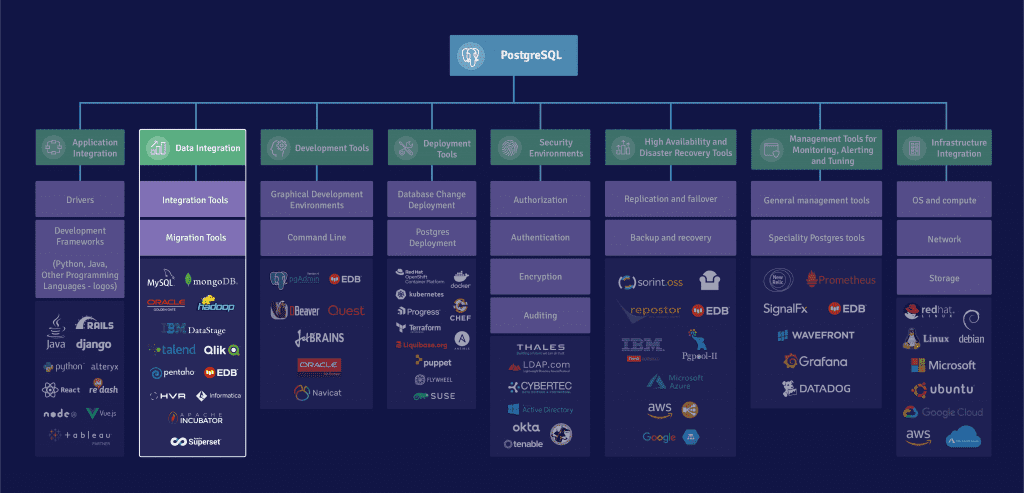
An increasing number of ETL vendors are adding PostgreSQL as a source and destination for their integration tools. According to a 2021 survey of visitors to the EDB website, the following tools are popular among PostgreSQL users (in alphabetical order):
- EDB*Loader
- EDB Replication Server
- IBM InfoSphere DataStage
- Informatica PowerCenter
- Microsoft SSIS
- Oracle GoldenGate
- Pentaho Data Integration
- Qlik (Attunity)
- Talend Open Studio
Migrating from legacy databases like Oracle and SQL Server is supported by enterprise-grade solutions such as EDB's Migration Tools and EDB Replication Server, as well as open-source tools likeora2pg. Open-source tools tend to be limited to the migration of data definitions and common data types. Specialized tools, such as EDB's Migration Portal and EDB Replication Server, offer more comprehensive features like change data capture for incremental migrations.
Stay tuned for the upcoming Development Tools post in this series. Meanwhile, to see the big picture regarding PostgreSQL integration our infographic Examine.
Source: Integrating PostgreSQL Part 2: Data Integration and Migration, EDB Team May 13, 2021
© Copyright EnterpriseDB Corporation 2020 EnterpriseDB Corporation
34 Crosby Drive Suite 201 Bedford, MA 01730
EnterpriseDB and Postgres Enterprise Manager are registered trademarks of EnterpriseDB Corporation. EDB and EDB Postgres are trademarks of EnterpriseDB Corporation. Oracle is a registered trademark of Oracle, Inc. Other trademarks may be trademarks of their respective owners.